
Технологичен портал
Sony Pregius S от 4-то поколение
Intro + Emergent Cameras with Sony Sensors

Pregius is a technology used in CMOS image sensors developed by Sony Semiconductor Solutions Corporation. It combines the low-noise performance of CCD technology with the high-speed and high-precision features of global shutter technology, making it ideal for industrial applications.
A new iteration of Pregius called Pregius S, features a back-illuminated structure for smaller sensor size and faster frame rates while maintaining high image quality. It also uses a stacked structure to accommodate additional signal processing functions.
Sony’s Pregius CMOS sensors have gone through four generations, with the latest being Pregius S. Each generation offers improvements, but certain features from older generations may still excel in specific aspects like resolution, frame rate, image quality, or sensor features. The choice of generation depends on the specific requirements of the application.

Front Illuminated vs Back Illuminated
Front-side illuminated (FSI) CMOS sensors incorporate a silicon substrate with a wiring layer to construct the photodiode. This arrangement offers a twofold advantage: firstly, it acts as a protective shield against extraneous light, preventing it from affecting the stored electrical charge in the memory region. Secondly, it facilitates signal transmission through the sensor and concurrently provides light shielding for the memory. Consequently, FSI pixel structures have been widely adopted in conventional CMOS image sensors. Nonetheless, the presence of wiring above the photodiode obstructs incident light, presenting challenges when attempting to miniaturize the pixels.
Conventional CMOS image sensors typically integrate pixel and analog logic circuits on the same chip, which leads to various constraints and challenges in terms of circuit size, noise, and overall optimization. To address these issues, the back-side illuminated (BSI) sensor architecture was developed. BSI sensors position the pixel’s circuit section beneath the photosensitive area, allowing more light to reach the sensor. This design results in smaller pixels, enabling the creation of more compact sensors that work well with smaller optical formats and offer higher resolutions.
The advantages of BSI sensors include reduced crosstalk between pixels, improved response times, and more accurate color reproduction. BSI sensors capture photons more efficiently, as they quickly reach the pixel section for detection. This design also increases the photosensitive area compared to the total pixel area, reducing the need for complex micro-lens designs. Additionally, BSI sensors enhance the chief ray angle (CRA) and bring the Bayer filter mask closer to the pixel, further improving image performance.

Предимства на 4th Generation Global Shutter CIS
Fourth generation Pregius S global shutter technology provides a multitude of benefits due to its newly developed BSI structure. These benefits include higher quality, precision, and productivity. Compared to previous generations, the BSI structure has a wider incident angle contributing to higher sensitivity, in addition to a light shielding structure and metal wirings under the photodiode which increases speed. These benefits enable a higher resolution in a smaller optical format and package, higher frame rate/picture quality, and more functionality with various applications.
New 2.74um Back Illuminated(BI) Global shutter Pixel Technology enables;
✓ Higher Resolution
In smaller optical format and package
Over 20M pixels in 29mm-size camera
(21×20 [mm] LGA package)
✓ High Frame Rate
With high picture quality
Up to 5Gbps/Lane x 8 (SLVS-EC IF)
High Saturation signal and Low Noise
✓ More Functionality
For various applications
Circuit wiring flexibility by stacking technology
Keep compatibility and improve usability

Higher Quantum Efficiency

Wider Incident Angle
- Improved lower incident angle performance (horizontal) due to the smaller pixel size by BI structure and pixel layout
- Direction dependency is reduced by significantly improving in horizontal and maintaining in vertical

Висока скорост

- The back-illuminated pixel structure offers a high degree of freedom when it comes to wiring layout.
- The produced readout frame rate is 2.4 times faster than conventional image sensors
- Imaging area: About 1.7 times greater
- Number of frames: About 1.4 times more
- High Speed (Output Data Rate): About 2.4 times faster
In addition to the benefits provided by this newly introduced technology, the 4th generation Pregius S sensor also boasts a number of improved features. The first of these features include dual ADC with built-in combination ensuring a higher dynamic range and lower output data/post-processing load. Additionally, short interval shutter function, and monitored output for exposure period for easy timing control of flashing.
Функции

Dual Trigger

Having divided the screen into two areas, and output images with different exposure times reveals gains in each area. It is also possible to crop an arbitrary area using Overlap ROI within each of the two areas.
Dual trigger has the following two functions which can be set together:
(1) Switching Exposure Time setting
(2) Switching Gain setting
Gradation Compression
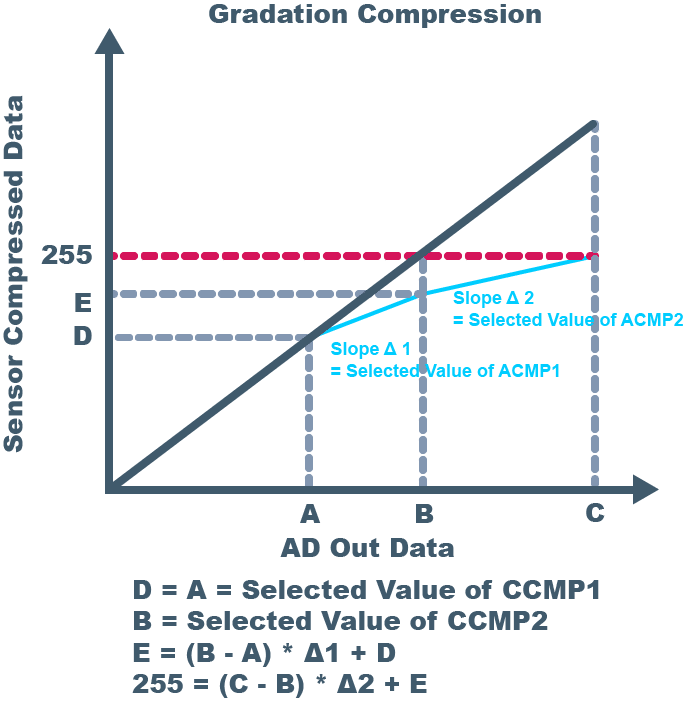
This process creates output data that is 8 bit. Gradation Compression compress as below. In the case where the setting results in compressed AD data over 8 bit, the value of the output data is clipped at 255. In the case of SLVS output, 0 and 255 are compressed data output as 1 and 254.
When the sensor outputs image data during Gradation Compression, it may be necessary for the following DSP to decompress the input data to process them properly. An example of the inverse formula is shown below. In this case, division operations in the formula can be simply done with shift operations since Δ1 and Δ2 are to the power of 2. In the case of SLVS output, 0 and 255 are compressed data output as 1 and 254. Because of this, the data can’t be decompressed.
Multi Exposure Trigger Mode

This sensor exposes the value of EXP_MAX (Chip ID = 04h Address = 0Eh, 0Fh), and the data of the frame is output after the last exposure. During the data output period, a start (fall input of XTRIG) is made possible by the exposure of the next frame, but it is not possible to expose and finish it (start input of XTRIG). The reflection timing position for registers marked “V” is the same as the timing on the Datasheet. However, during Multi Exposure Trigger mode, it is reflected by the trigger of the last exposure.


Multi Frame ROI Mode
This function became possible due to the sequence control set by the gain and the exposure period of each frame. This is assuming Multi Frame ROI 2 frames or Multi Frame ROI 4 frames to be one-set. Cropping position can set maximum 16 areas that specified by horizontal 4 points and vertical 4 points, regarding effective pixel start position as origin (0, 0) in all pixel scan mode.

Short Exposure Mode

This mode can set short exposure time by controlling registers. There is a possibility that this mode affects image quality. This mode may be used after thorough evaluation. There is a possibility that the exposure time of this mode can change by ± 500 ns depending on the sample, environment, temperature, voltage, etc. In the instance where an intense light source is used, the exposure time may be changed by PLS and so on.
Short Interval Shutter
This function results in twice the exposure at shutter intervals of 2 μs or more. It is assumed to be used to expose two consecutive frames to exposure lights respectively in a short interval. For example, for Particle Image Velocimetry (PIV) which is used for detection of particles or the measurement of particle velocity. The first and second exposure period, as well as the interval between 1st and 2nd exposures (exposure prohibition period) can be adjusted by the register (unit: 13.47 ns). For exposure period and prohibited exposure period, control signals can be monitored using TOUT0 to TOUT2.

Термометър
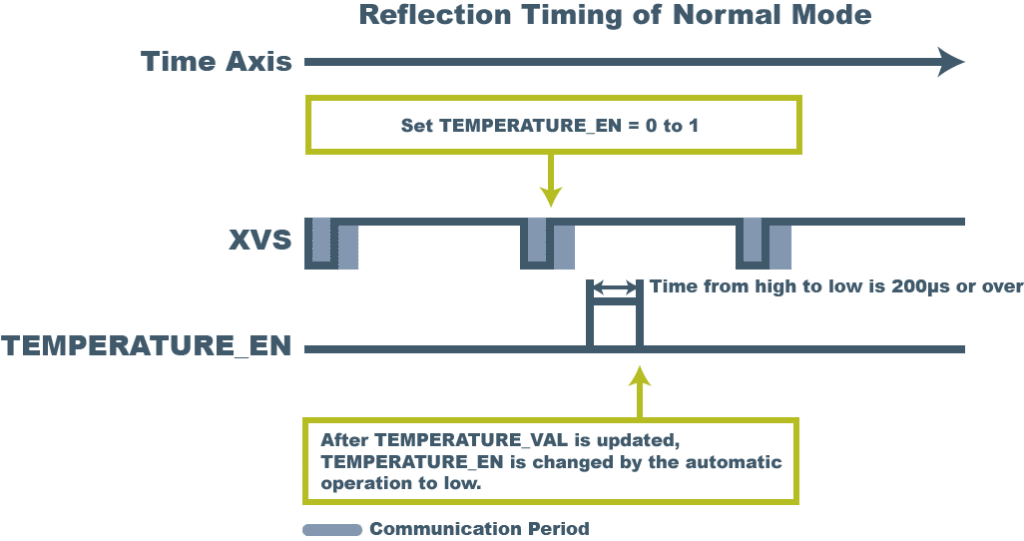
The reading timing of temperature is as below.
After setting TEMPERATURE_EN to 1, the measured temperature (TEMPERATURE_VAL) is updated. After the measured temperature update is finished, TEMPERATURE_EN is changed from High to Low by the automatic operation. The time that TEMPERATURE_EN changes from High to Low by the automatic operation is 200 μs or over. Temperature readout should be measured when TEMPERATURE_EN is Low. After that, the value of TEMPERATURE_VAL is held until the next timing of setting “1” into TEMPERATURE_EN. Writing of TEMPERATURE_EN and reading of the data from TEMPERATURE_VAL are possible outside of the prohibited communication period. The reflection timing when setting TEMPERATURE_EN during the communication period is shown below.
Dual ADC
This function outputs 2 different pieces of gain data from the same pixel. By combining these images, a high bit or HDR image can be achieved.
Dual ADC has the following two modes:
Without combination: The lines for low gain and high gain line are alternately output after the frame information line (Embedded data line at SLVS-EC) as below.
With built-in combination: Low gain lines and high gain lines are combined and output. Therefore, the number of output lines is halved with respect to the combining-less mode.


Относно технологиите за бързо зрение

Ето едно резюме на това какво представлява Emergent…
- 10+ награди за иновации и пионерство в движението за високоскоростно изображение GigEVision
- 10+ години доставка 10GigE камери с повече от 140 модела
- 5+ години доставка 25GigE камери с повече от 55 модела
- 2+ години доставка 100GigE камери с повече от 16 модела
- Лидер в производителността на технологиите за камери
- Фокус върху високоскоростен Ethernet/GigEVision
- Фокусиран върху обработката на високоскоростни данни за изображения
- Област на сканиране намлява Линейно сканиране модели
- UV, NIR, поляризирани, цветни, моно модели за мултиспектрални приложения
- Emergent eSDK за пълна гъвкавост на приложенията
- неочакван eCapture Pro за висококачествено софтуерно решение
- Най-пълната гама от продукти и поддръжка за приложения за високоскоростна обработка на изображения
- Всякаква скорост, всякаква резолюция, всякаква дължина на кабела
- Наличен СЕГА!
Ние сме многократно награждавана компания, фокусирана върху високоскоростни GigEVision продукти.
Имаме дългогодишен опит в доставката на продукти със скорости от 10GigE до 100GigE.
Ние сме силно фокусирани върху предоставянето на цялостни технологии и поддръжка за приложенията на нашите клиенти.
Можем да изпълним повечето изисквания на приложението.
И накрая, представените продукти са вече налични.
Въвеждане на 10GigEVision и по-високи технологии
Ето един бърз преглед на приемането на продуктите на GigEVision, вариращи по скорости от 10GigE до 100GigEEmergent показа как може да се постигне максимална производителност и отвори много пазари, включително машинното зрение, за използването на такива технологии. Някои компании едва сега използват нашите усилия за пускане на продукти с 25G и по-висока скорост, но все още има път до пускането на сертифицирани и високопроизводителни продукти.

Фигура: Emergent Vision Technologies е първият доставчик на камери, базирани на 10GigE, 25GigE, 50GigE и 100GigE интерфейси.
