

Cámaras RDMA y GigE Vision 3.0: La perspectiva de Emergent
Cámaras RDMA y GigE Vision 3.0: La perspectiva de Emergent
All of Emergent’s area-scan and line-scan cameras are GigE Vision 3.0 / RDMA (RoCEv2)-certified by A3 as of October 2026. This is our guide to how applying standards such as RDMA and optimized GVSP results in system performance for 10, 25, 100 and 200GigE machine vision cameras.
Entering our 20th year of building the fastest GigE Vision systems
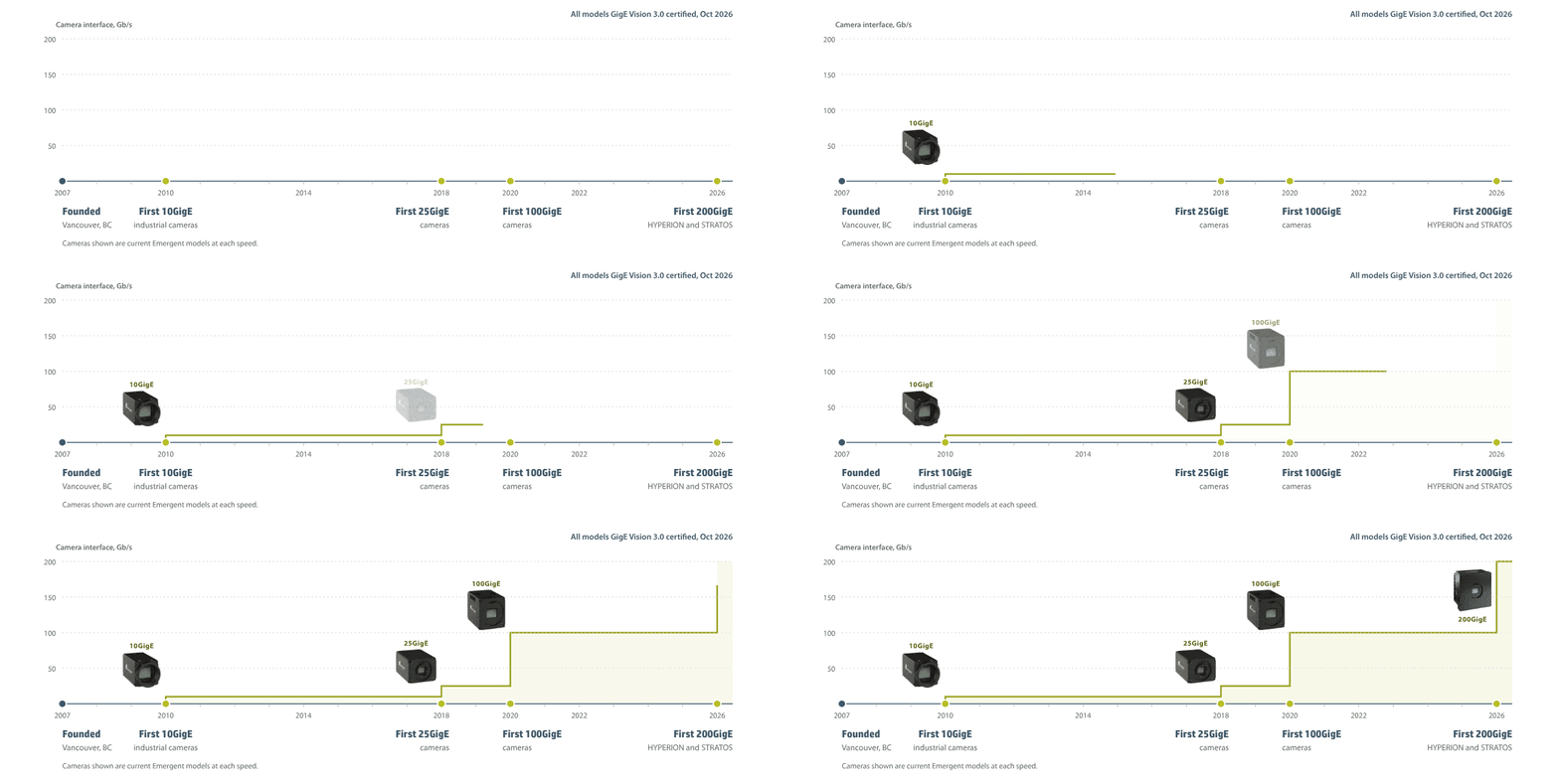
RDMA is new to GigE Vision. High-bandwidth Ethernet cameras are not. Emergent is entering its 20th year of building them, longer than anyone. We shipped the first industrial 10GigE cameras in 2010, then led every step since: first 25GigE (2018), first 100GigE (2020), and in 2026 the world’s first 200GigE area-scan and line-scan cameras.
| Fácil de usar | Primero lanzado | Current Emergent Cameras |
|---|---|---|
| 200GigE | 2026 | Area-Scan: HYPERION | Line Scan: STRATOS |
| 100GigE | 2020 | Area-Scan: ZENITH | Line Scan: PINÁCULO |
| 25GigE | 2018 | Area-Scan: PERNO | Line Scan: ACEL |
| 10GigE | 2010 | Area-Scan: EROS & HR | Line Scan: EROS & LA PAZ |
That history matters for RDMA because the hard problems in multi-camera Ethernet imaging are not in the camera. They sit in the NIC, the switch, the driver, the server’s memory and PCIe layout, and the GPU. Emergent designs all of them together: cameras, our own Theia, Hermes and Zeus NICs, validated switches, the eSDK Pro SDK and eCapture Pro application software.
The result is the support model customers buy us for:
- Systems validated end to end. eCapture Pro is validated to 500+ cameras; Emergent has deployed 50+ cameras on a single PC and 500+ across multiple PCs.
- Zero-data-loss performance we stand behind. Our application engineers specify the camera, NIC, switch, server and storage together and verify performance before the system ships. We offer turnkey systems and guarantee system performance.
- Engineers, not a ticket queue. The people who write our drivers help design, tune and commission your system, from first quote through deployment.
With GigE Vision 3.0 now ratified, every Emergent camera model is certified to GigE Vision 3.0 / RDMA (RoCEv2). That includes our 200GigE HYPERION and STRATOS cameras, which run both GigE Vision 3.0 RDMA and our optimized, zero-copy GVSP, built on Emergent’s mature driver ecosystem. This article explains when each one is the better choice.
What to ask any RDMA camera vendor
GigE Vision 3.0 turns RDMA into a checkbox on a datasheet. It does not tell you whether a vendor can deliver your system, whether that is a single camera or a multi-camera installation. For some vendors the problems start with one 10GigE camera: dropped frames, busy CPU cores, and a GPU waiting on memory copies. They become far more pronounced with multi-camera systems and at 25GigE, 100GigE and 200GigE, where every copy, buffer and PCIe lane is multiplied. Before you commit, ask these questions about the system you plan to build, not just the camera.
| Solicite la ayuda confidencial de | What You’ll Often Find | What Emergent Delivers |
|---|---|---|
| Is every camera certified, at every speed? | GigE Vision 3.0 limited to some speeds or families, with the rest left on 2.x | Every model, 10GigE to 200GigE, certified to GigE Vision 3.0 with RDMA / RoCEv2 capability, and every model also runs zero-copy GVSP. |
| Can you show me a multi-camera system? | Demos of one camera into one PC | Emergent specializes in multi-camera systems, with the largest deployed system having over 500 cameras over multiple servers. At VISION 2026, every Emergent demo is multi-camera, including at 100GigE. |
| Do frames reach the GPU without a CPU copy? | GPUDirect not mentioned; frames stop in system RAM | GPUDirect into GPU memory, including through Emergent and third-party NICs |
| Does the GPU path work on Windows? | Linux only, or not stated | Windows y Linux |
| What is your fastest shipping camera? | 10 or 25GigE; 100GigE cited only as a network speed | 100GigE cameras since 2020; 200GigE HYPERION and STRATOS in Q1 2027 |
| Can one camera feed several PCs? | No abordado | Multicast GVSP on the same certified camera |
| Who is responsible for zero frame loss? | You are; performance claims come without test setups, or from software-only vendors relying on third-party hardware | Emergent specifies cameras, NICs, switches, servers and software together; Emergent guarantees performance. |
The GPU question matters most for AI deployment. Without GPUDirect, every frame RDMA delivers to system RAM is copied again across PCIe to the GPU, and at 25GigE and above that copy becomes the new bottleneck.
RDMA standardizes how a frame leaves the camera. Emergent takes responsibility for where it goes next.
The sections below answer each of these questions in turn: how frames move, when RDMA or optimized GVSP is the better transport, how GPUDirect works on Windows and Linux, and how to choose an architecture.
How GigE Vision cameras move data: GVSP, RDMA and zero-copy
Every GigE Vision camera streams over UDP/IP. What differs is how the receiving PC turns packets into images, and that is where CPU load, latency and frame loss are decided.
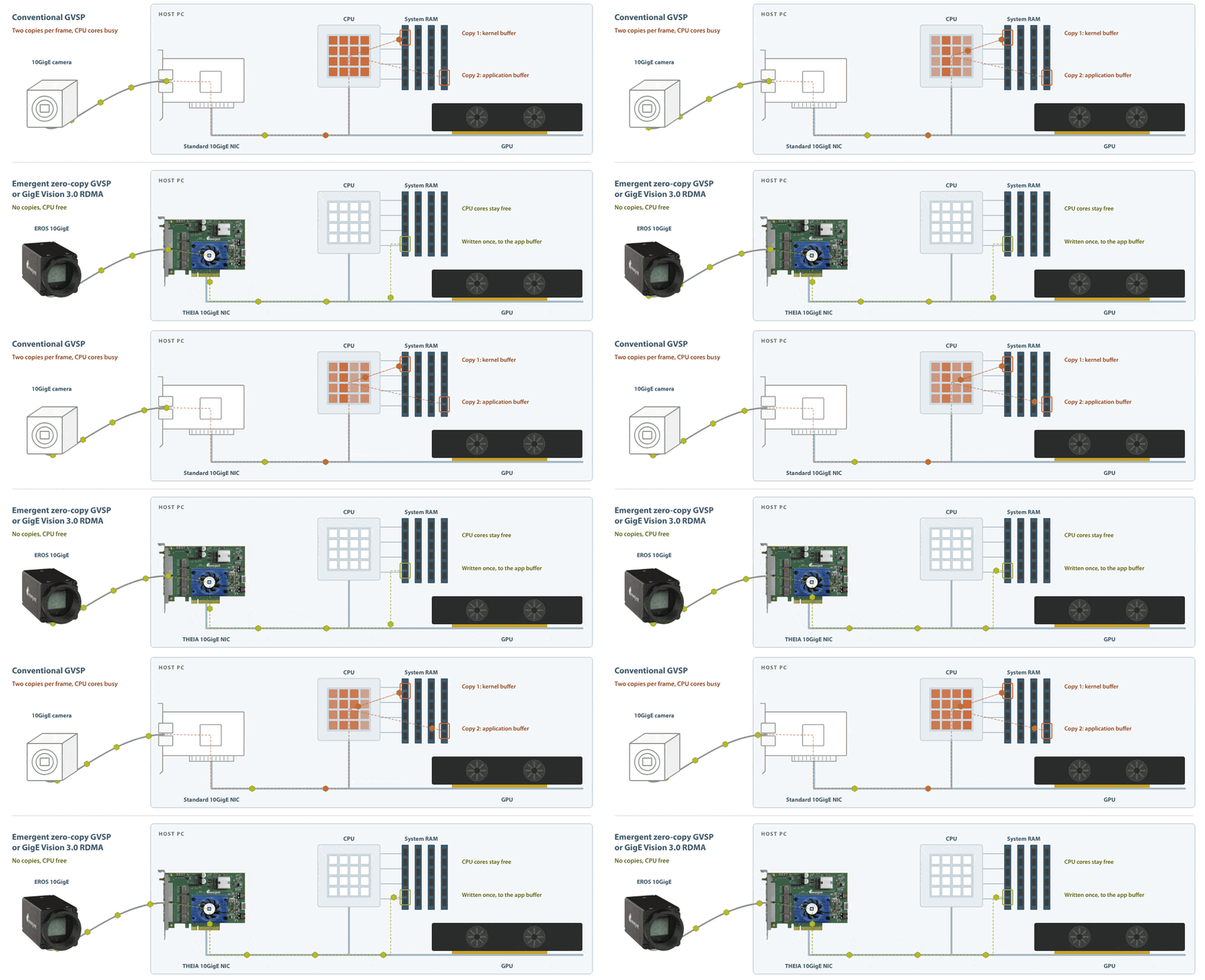
GVSP (GigE Vision Streaming Protocol). The original GigE Vision transport, in use since 2006. Each frame is a leader packet, payload packets and a trailer. It is connectionless, so one camera can multicast to several PCs. Its weakness is not the protocol but the receiver: a conventional driver copies every packet through the OS network stack, then copies it again into an image buffer. At 10GigE and above, that copying can triple memory bandwidth and saturate CPU cores.
Optimized, zero-copy GVSP. Emergent’s mature driver ecosystem uses hardware header splitting on performance NICs. The NIC places image payload directly into the application’s buffer, and the kernel never touches it. This is the same technique broadcast uses for SMPTE ST 2110 video. It keeps GVSP’s multicast and standard compliance while removing the copies.
RDMA over RoCEv2 (GigE Vision 3.0). Ratified by A3 in April 2026, GigE Vision 3.0 adds the GigE Vision RDMA Streaming Protocol (GVRSP). The camera writes image data straight into pinned host memory through an RDMA-capable NIC. The NIC handles ordering, retransmission and flow control in hardware. Streams are connected (camera to one receiver) and need a RoCEv2-capable NIC on the host.
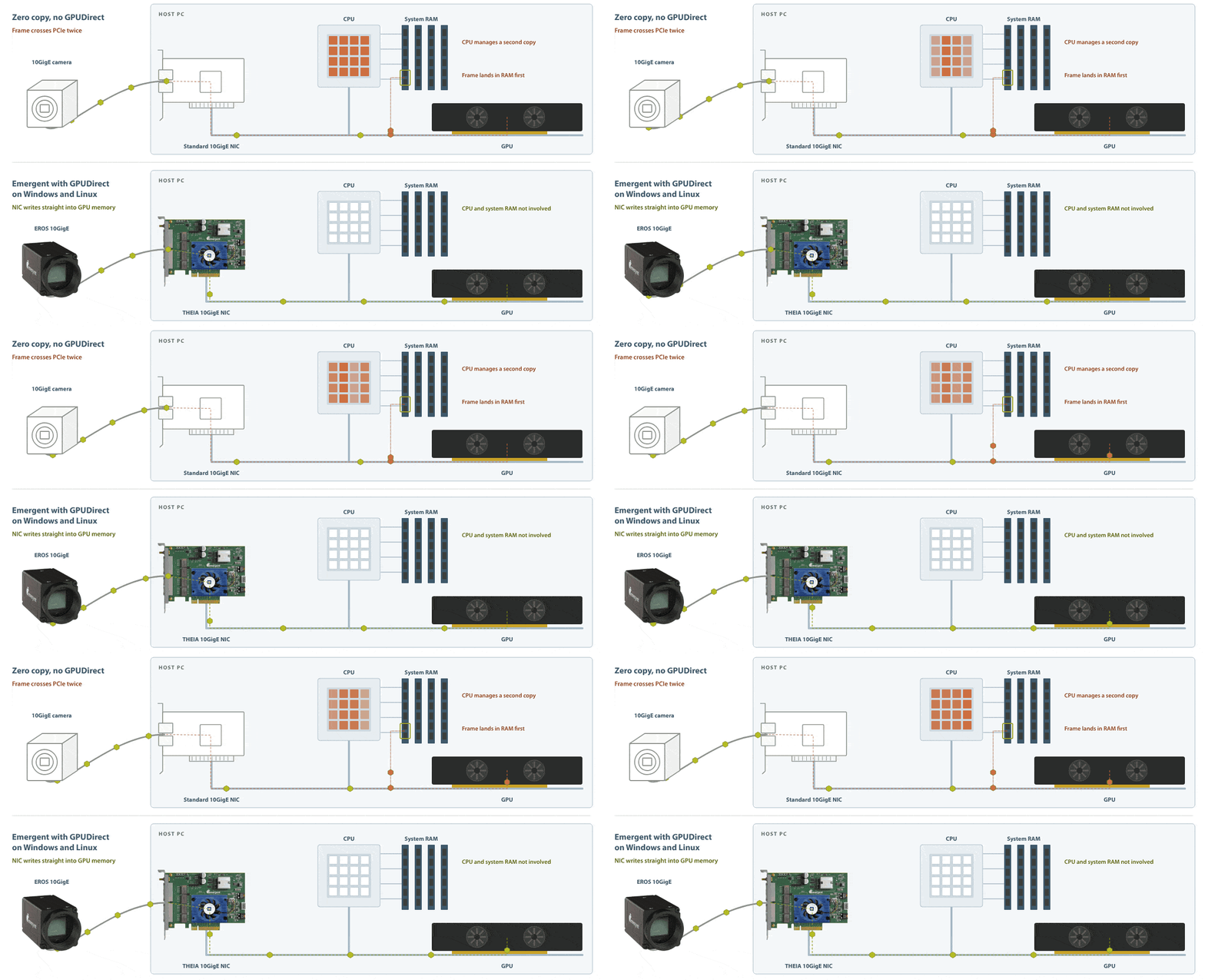
GPUDirect. A separate layer that works with either transport. With GPUDirect, the NIC writes image data straight into GPU memory, skipping system RAM and the CPU entirely. This is the step that matters most for AI and real-time processing, and it is where vendors differ the most.
GigE Vision 3.0 RDMA vs. optimized GVSP: Emergent’s view
RDMA and optimized GVSP reach the same goal, zero-copy image transfer with near-zero CPU load, by different routes. RDMA is the right choice for many new systems, and Emergent cameras are certified for it. But most of the gains vendors attribute to RDMA come from removing memory copies, and Emergent’s optimized GVSP, backed by our mature driver ecosystem, has done that for years.
| Conventional GVSP | Emergent Zero-Copy GVSP | GigE Vision 3.0 / RDMA (RoCEv2) | |
|---|---|---|---|
| Memory copies on host | 2+ per frame | None (hardware header split) | None (direct placement) |
| CPU load at 10–100GigE | Alto | Cerca de cero | Cerca de cero |
| Packet loss handling | Software resends | Lossless by system design; resends available | NIC hardware retransmit |
| Multicast to several PCs | Sí: | Sí: | No, connected point-to-point |
| NIC requirement | Año | Emergent or validated performance NICs | RoCEv2-capable NIC |
| GPUDirect | Rara vez | Windows y Linux | Windows and Linux (only Emergent) |
| Estándar | GigE Vision 1.x–2.x | GigE Vision 2.x compliant | GigE Vision 3.0 |
| Mejor ajuste | 1–5GigE, low camera counts | Multicast, redundancy, distributed processing, existing fleets | New builds, third-party software interop, many cameras per NIC |
Where RDMA wins. Interoperability is the headline. Any GigE Vision 3.0 host software can now receive an Emergent camera at full rate without our driver. RoCEv2 NICs from Broadcom and NVIDIA are inexpensive, and hardware retransmission makes the link tolerant of a busy network.
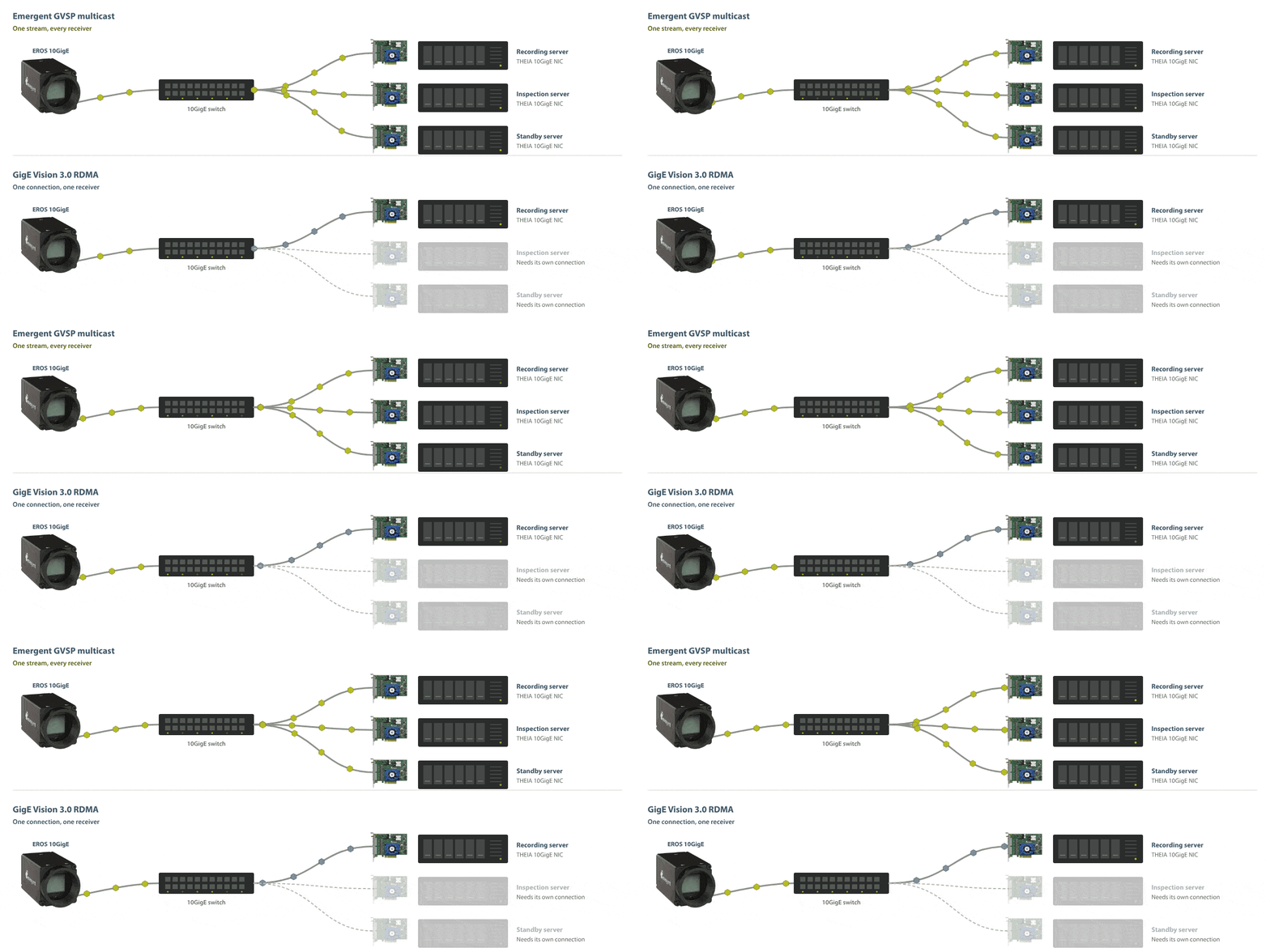
Where optimized GVSP still wins. Multicast lets one camera feed a recording server and an inspection server at once, or fail over instantly to a standby PC. RDMA’s connected model cannot do this. GVSP also avoids connection setup and per-stream NIC resources, which matters at 50+ cameras per server.
What doesn’t change. Neither protocol rescues a poorly designed system. Buffer overruns, PCIe contention, NUMA placement, switch oversubscription and storage throughput decide whether a 36- or 500-camera system loses frames. Emergent specifies and validates those for you, whichever transport you choose.
Our recommendation: start from the application, not the protocol. Emergent supports both and will tell you which fits your architecture.
GPUDirect on Windows and Linux with Emergent
Zero copy into system memory is only half the job. For AI inference, 3D reconstruction or real-time inspection, the image still has to reach the GPU, and a CPU-driven copy across PCIe brings back the bottleneck RDMA just removed. NVIDIA GPUDirect lets the NIC write frames straight into GPU memory. Emergent supports it on both Windows y Linux, including with Emergent’s own NICs.
What it looks like in practice. At VISION 2026, Emergent captured visitors in real-time 4D Gaussian splatting (4DGS) with 36 EROS HE-12000-SBL 10GigE cameras (12.3MP color at up to 60fps, Sony IMX545). All 36 cameras were synchronized to 1µs using PTP, with audio locked to the same timing. One switch carried the 36 simultaneous 10GigE streams to two high-performance servers, where GPUDirect delivered every frame straight into GPU memory. Each server ran with two NVIDIA RTX PRO 6000 Blackwell GPUs. eCapture Pro handled acquisition, synchronization and real-time 4DGS processing and production, and the scenes were rendered in real time with the open-source LichtFeld Studio Gaussian splatting software.
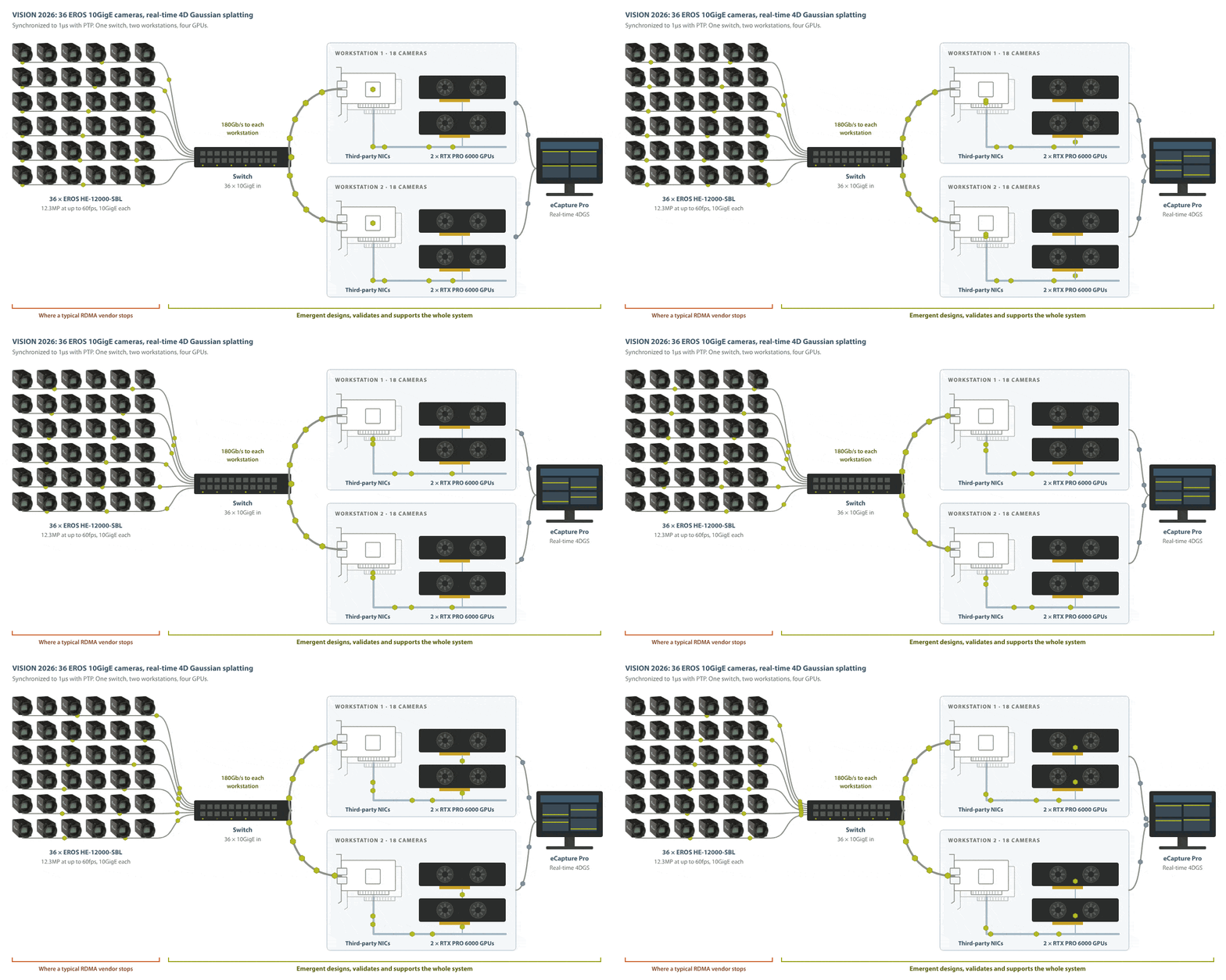
See this camera example in action
GPUDirect: Frames go from the NIC straight into GPU memory
What it takes, why it matters and how Emergent deploys it on Windows and Linux.
| Qué se requiere | Why it matters most | How Emergent deploys it |
|---|---|---|
| NVIDIA professional or data-center GPU with GPUDirect RDMA support | One PCIe transfer per frame instead of two | Match: camera, Emergent NIC and GPU specified together. THEIA 10GigE, HERMES 10/25GigE, ZEUS 100GigE. |
| A NIC and driver that can write directly into GPU memory | No CPU copy, so cores stay free for your application | Place: NIC and GPU slots chosen for a direct PCIe path |
| NIC and GPU on a direct PCIe path, ideally under the same root complex or PCIe switch | System memory bandwidth left for everything else | Stream: our mature driver ecosystem lands frames in GPU buffers through eSDK Pro and eCapture Pro |
| Linux: NVIDIA peer-memory support in the driver stack | Lower, steadier latency into AI inference and image processing | License: Rivermax on Windows through Emergent’s direct NVIDIA partnership; Linux supported as well |
| Windows: NVIDIA Rivermax, licensed through a direct NVIDIA partnership | More cameras per server as links climb to 100GigE and 200GigE | Support: Emergent engineers commission and support the whole data path |
| A zero-copy stream: optimized GVSP or GigE Vision 3.0 RDMA |
Headroom to scale: CPU and memory stay free as camera counts grow |
Verificar: performance confirmed before the system ships, and guaranteed |
Get started with our application engineering team
Emergent’s application engineering team can help you specify a system verified for performance before it ships. We offer turnkey systems and guarantee system performance.
Experience the difference of working with the innovators, not the imitators.


